

Las Vegas rents declined slightly in September, continuing a modest downward trend that began earlier this summer.
According to the Zillow Observed Rent Index (ZORI), the typical rent across the Las Vegas metro was $1,732 in September 2026, down 0.1% from the previous month and up 0.5% from a year earlier.
Las Vegas Rental Market at a Glance
Typical Las Vegas Metro Rent: $1,732
Month-over-Month Change: −0.1%
Year-over-Year Change: +0.5%
U.S. Typical Rent: $1,932
U.S. Year-over-Year Change: +2.7%
Source: Zillow Observed Rent Index (ZORI), September 2026.
Las Vegas Rent Trends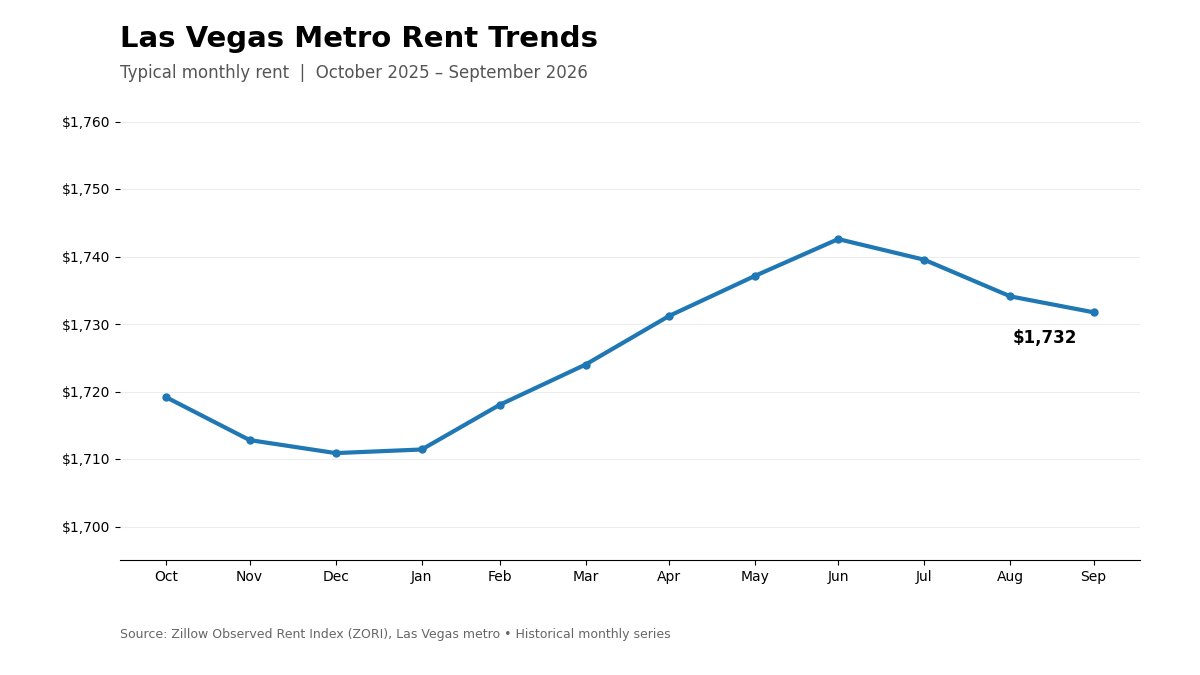
Las Vegas rents increased gradually through the first half of 2026 before beginning to ease during the summer. Zillow’s historical data shows typical metro rents rising from approximately $1,711 in December 2025 to $1,743 in June 2026. Rents subsequently declined to $1,732 in September.
Despite these recent declines, rents remain slightly higher than a year ago. However, annual growth of 0.5% is well below the national rate of 2.7%.
The overall trend suggests a relatively stable market with some recent softening rather than a significant decline in rental values.
What Changed This Month?
September brought another modest decline in typical Las Vegas rents. Zillow reported a 0.1% month-over-month decrease, following declines in July and August.
Although the monthly changes have been relatively small, three consecutive months of declining rents are worth watching.
The latest figures suggest that rental pricing remains competitive, particularly for properties facing substantial competing inventory.
What Does This Mean for Las Vegas Landlords?
Our overall approach remains largely unchanged: price rental properties based on current market competition rather than relying on expectations of rent growth.
With metro-wide rents essentially flat compared with a year ago, owners should be cautious about setting asking rents substantially above comparable available properties without a clear reason the home warrants a premium.
Property condition, location, amenities and competing rental inventory can have a greater effect on leasing performance than the broader metro trend.
At Rentals America, we also emphasize preparing homes thoroughly before marketing. Cleanliness, maintenance and presentation can help a property stand out when prospective renters have multiple options.
When a property isn’t generating sufficient activity, responding to the market early can often be preferable to allowing additional vacancy while holding out for a higher rent.
Related: How to Prepare Your Home for Rent
Las Vegas Rental Market Outlook
For now, the Las Vegas rental market appears relatively stable, although the recent declines suggest some softening.
Rents remain slightly higher than a year ago, but the downward movement since June is worth monitoring. It remains to be seen whether these changes reflect a temporary adjustment or the beginning of a more sustained trend.
We’ll continue watching rental pricing and competition to identify whether the market stabilizes or experiences additional declines.
Individual properties can perform differently depending on location, property type, condition and price. Rental homes in Las Vegas, Henderson, North Las Vegas and other parts of the metro may not follow the metropolitan average.
For a deeper look at rental supply, demand, long-term trends and the factors affecting local rental-property performance, visit our Las Vegas Rental Market Report.
Las Vegas Rental Market FAQ
What is the typical rent in the Las Vegas metro?
According to Zillow’s Observed Rent Index, the typical Las Vegas metro rent was $1,732 in September 2026.
Are Las Vegas rents increasing or decreasing?
Las Vegas rents remain slightly higher than a year ago but have declined modestly in recent months. Zillow’s historical data shows rents up 0.5% year over year and down 0.1% month over month in September.
About the Data
Market data is based on the Zillow Observed Rent Index (ZORI) for the Las Vegas metropolitan area. Zillow periodically revises historical data. Metro-wide trends provide useful context, but individual properties and submarkets may perform differently.