



When a resident stops paying rent or violates the lease, property owners need to understand their options for recovering possession while complying with Nevada law.
Eviction is sometimes necessary, but the process involves more than giving a resident notice to move. Nevada has specific requirements for eviction notices, court filings, and the enforcement of removal orders. The steps also depend on whether the eviction involves unpaid rent, a lease violation, or the termination of a tenancy.
At Rentals America, we manage rental homes throughout the Las Vegas area and understand the importance of addressing these situations promptly. For property owners, knowing how the process works can help establish realistic expectations, limit unnecessary delays, and protect their investment.
What Are the Steps in the Nevada Eviction Process?
Nevada provides two primary legal procedures for residential eviction: summary eviction and formal eviction.
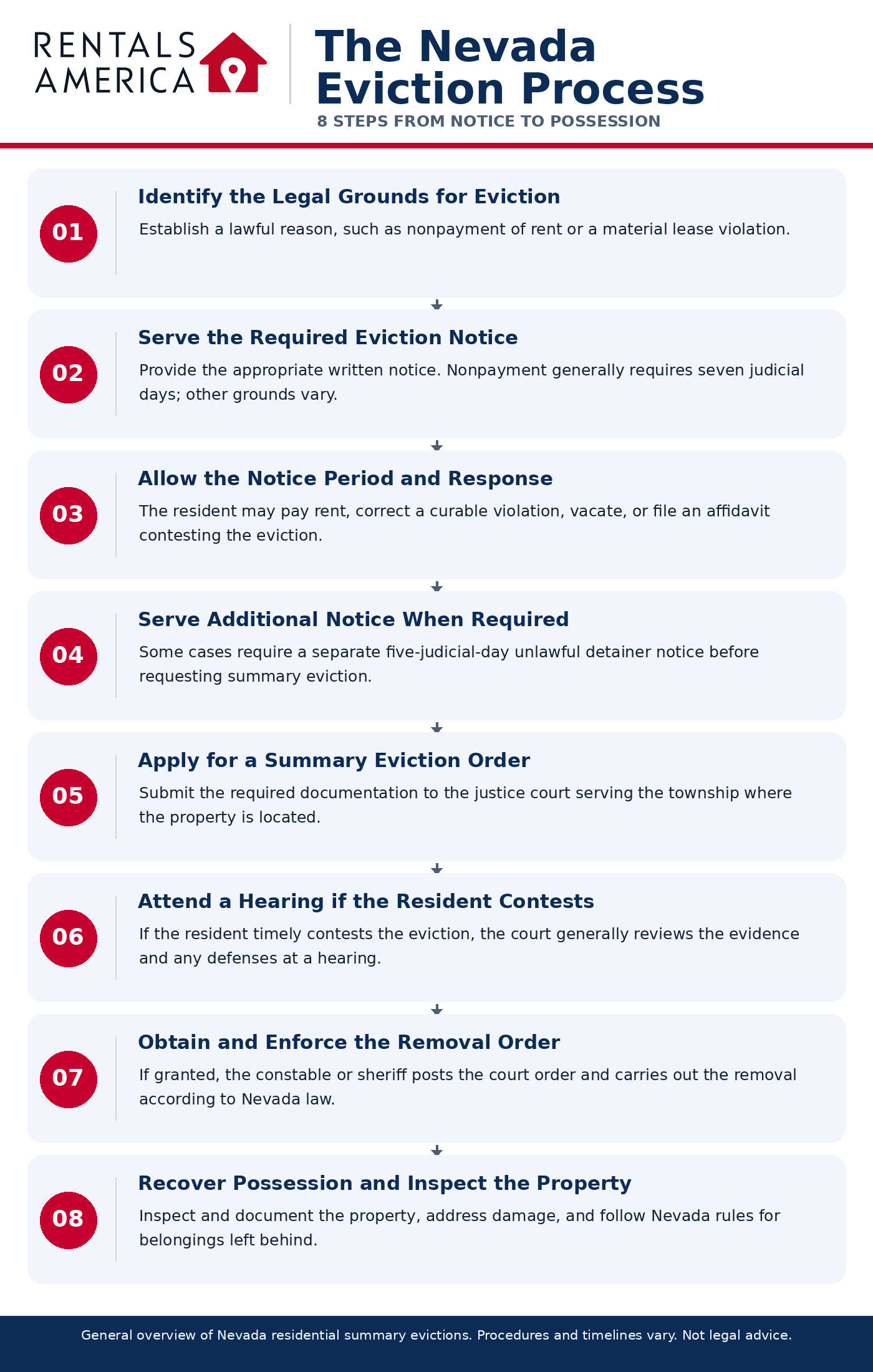
Summary eviction is commonly used for straightforward residential cases and generally follows these steps:
- Identify the legal grounds for eviction.
- Serve the appropriate eviction notice.
- Allow the required notice period and opportunity to respond.
- Serve an additional unlawful detainer notice when required.
- Apply to the court for a summary eviction order.
- Attend a hearing if the resident contests the eviction.
- Obtain and enforce the court’s removal order.
- Recover possession and assess the property’s condition.
Not every case requires all eight steps. For example, nonpayment cases generally begin with a seven-judicial-day notice, while lease violations typically require an additional notice before the landlord can request eviction.
A resident may also resolve the issue or voluntarily vacate before the process is completed.
Step 1: Identify the Legal Grounds for Eviction
Nevada landlords must have a lawful basis for recovering possession of a rental property.
Common reasons include:
- Nonpayment of rent.
- Material violations of the lease agreement.
- Nuisance or certain serious misconduct.
- Unauthorized occupants or other prohibited activity.
- Remaining in possession after a tenancy has lawfully ended.
In our experience, nonpayment of rent is the most common reason for eviction. These cases are often more straightforward because the lease and payment ledger help establish the resident’s obligations and delinquent balance.
Other violations may be more complicated. For example, an unauthorized pet, repeated disturbances, or improper use of the property may require additional documentation to demonstrate the violation.
The reason for eviction determines which notices must be served and which legal procedures apply.
Step 2: Serve the Appropriate Eviction Notice
Nevada requires landlords to provide specific written notices before pursuing eviction.
Nevada generally uses judicial days for the residential nonpayment notice period. Judicial days exclude weekends and court holidays.
Common Nevada Eviction Notices
| Reason | General Notice Requirement |
|---|---|
| Nonpayment of rent | 7 judicial days to pay, vacate, or contest |
| Material lease violation | 5-day notice to cure or vacate |
| Nuisance or certain serious misconduct | 3-day notice to surrender |
| Termination of a month-to-month tenancy | Generally 30-day notice |
| Termination of a week-to-week tenancy | Generally 7-day notice |
For many nonpayment cases, the seven-judicial-day notice also serves as the unlawful detainer notice.
For other grounds, including lease violations, nuisance, and no-cause termination of a periodic tenancy, an additional five-judicial-day unlawful detainer notice is generally required before proceeding with summary eviction.
Applicable requirements: NRS Chapter 40
How Are Eviction Notices Served in Nevada?
Nevada has specific rules governing who may serve eviction notices and how service must be documented.
Under NRS 40.280, notices generally must be served by an authorized person, such as a sheriff, constable, licensed process server, or qualifying agent of a Nevada attorney.
Depending on the circumstances, service may involve personal delivery or another legally authorized method.
At Rentals America, we coordinate with our eviction attorney and authorized service providers to help ensure notices are prepared, served, and documented correctly.
Improper service can delay an otherwise valid eviction, making this an important part of the process.
Step 3: Allow the Notice Period and Opportunity to Respond
Once the appropriate notice has been served, the resident has the legally required period to respond.
In a nonpayment case, the resident generally has until the close of business on the seventh judicial day following service to pay the required rent, surrender possession, or file an affidavit contesting the eviction.
A resident who receives a notice for a curable lease violation may be able to preserve the tenancy by correcting the violation within the applicable period.
Can Landlords Accept Partial Payments?
Payment arrangements may occasionally be appropriate when a resident experiences a temporary financial hardship and has a credible plan to bring the account current.
However, accepting partial rent during an eviction can create legal complications.
Nevada law contains specific provisions governing rent payments and the amounts a landlord may require to resolve a nonpayment notice. Landlords should not assume that accepting a partial payment leaves an existing notice or eviction proceeding unaffected.
When a payment arrangement is appropriate, we recommend documenting the terms carefully and coordinating with the eviction attorney before accepting payments that could affect the case.
Our goal is to resolve temporary payment problems when practical without allowing an unpaid balance to grow indefinitely.
Step 4: Serve an Additional Unlawful Detainer Notice When Required
For many Nevada evictions involving something other than nonpayment of rent, the initial termination notice is not the final notice required before requesting summary eviction.
For example, a material lease violation generally involves:
- A five-day notice identifying the violation and providing the required opportunity to cure.
- If the violation is not resolved, a separate five-judicial-day unlawful detainer notice.
Similarly, a month-to-month tenancy that has been properly terminated may require an additional five-judicial-day unlawful detainer notice if the resident remains in possession.
During that second notice period, the resident generally has the opportunity to contest the eviction by filing an affidavit with the appropriate court.
For nonpayment of rent, the seven-judicial-day notice generally serves both purposes, so this additional notice is ordinarily unnecessary.
The distinction matters because failing to serve a required notice can result in delays or dismissal.
Step 5: Apply for a Summary Eviction Order
If the required notice period expires and the resident has not complied or surrendered possession, the landlord may apply for summary eviction.
For Las Vegas-area rental properties, the application is generally submitted to the justice court serving the township where the property is located.
Properties in the Las Vegas area may fall within different justice court jurisdictions, depending on their address.
At Rentals America, we coordinate with our eviction attorney and provide the documentation needed to support the application, including:
- The lease agreement.
- Copies of the applicable notices.
- Proof of proper service.
- A current rent ledger for nonpayment cases.
- Relevant correspondence or evidence of other lease violations.
Accurate documentation helps the attorney prepare the case and reduces the likelihood of unnecessary delays.
Does Every Nevada Eviction Require a Court Hearing?
No. Nevada’s summary eviction procedure allows the court to issue an eviction order without a hearing when the resident does not timely contest the notice, provided the landlord has satisfied the legal requirements.
However, the court may require additional information or schedule a hearing when necessary.
When Is Formal Eviction Necessary?
Although summary eviction is commonly used for residential cases, some disputes require a formal eviction action.
Formal eviction generally begins with the filing of a complaint and service of a summons. It follows a more traditional civil court process and may involve additional pleadings, hearings, or a trial.
A formal action may be necessary when a case cannot be resolved through summary eviction, including certain disputes involving legal defenses or more complicated possession claims.
Because formal eviction can take longer and involve greater legal expenses, we work with our attorney to determine the appropriate procedure for each case.
Step 6: Attend a Hearing if the Resident Contests the Eviction
Nevada residents have the right to contest a summary eviction by filing the appropriate affidavit with the court within the required notice period.
When a resident timely contests the eviction and the landlord proceeds with the required filing, the court generally schedules a hearing to consider the dispute.
The judge may examine the lease, notices, payment records, service documentation, and any defenses raised by the resident.
Possible outcomes include:
- Granting the landlord’s request for summary eviction.
- Denying the request.
- Requiring the dispute to proceed through a formal eviction action if a qualifying legal defense prevents resolution through the summary process.
Summary eviction is intended to provide a relatively efficient procedure, but it is not appropriate for every disputed case.
Maintaining complete records throughout the tenancy helps our attorneys evaluate the case and respond to disputes.
Step 7: Obtain and Enforce the Court’s Removal Order
If the court grants summary eviction, it issues an order authorizing removal of the resident.
Under Nevada’s summary eviction statute, the sheriff or constable is generally directed to post the removal order at the property within 24 hours after receiving it.
The resident’s removal is then generally scheduled not earlier than 24 hours and not later than 36 hours after the order is posted, subject to applicable stays or other legal circumstances.
When a lockout is necessary, we coordinate with the appropriate enforcement officer and locksmith to recover possession.
Property owners should not attempt to bypass the legal process by changing locks, removing a resident’s belongings, or shutting off essential utilities.
Step 8: Recover Possession and Assess the Property
Once possession has been lawfully restored, the next priority is evaluating the property’s condition and preparing it for another resident.
We inspect the home, document damage, identify necessary repairs, and begin coordinating the work needed to return the property to rent-ready condition.
What Happens to Belongings Left Behind?
Nevada has specific requirements for handling personal property left behind after an eviction.
Under NRS 118A.460, landlords generally must provide for safe storage of abandoned belongings for 30 days.
Additional notice requirements apply before disposal, and former residents must be given a reasonable opportunity to retrieve essential personal effects during the five-day period following eviction or lockout.
These requirements can affect how quickly the property can be cleared and prepared for another tenancy.
The landlord must also address security deposit accounting, unpaid balances, and any additional claims arising from the tenancy.
How Long Does an Eviction Take in Las Vegas?
The timeline depends on the reason for eviction, the type of notice required, whether the resident contests the case, and the court’s schedule.
For a straightforward nonpayment case, the initial notice period is seven judicial days. After that, the landlord may apply for summary eviction if the resident has not paid, vacated, or successfully contested the matter.
An uncontested case may be completed relatively quickly once the notice expires and the court processes the application.
However, landlords should not assume that possession will be recovered immediately after the seventh day.
Additional time may be required for:
- Proper service of notices.
- Court review and processing.
- A hearing if the resident contests the eviction.
- Scheduling and enforcement of the removal order.
- Any stay or other court-authorized delay.
Lease violations and other nonpayment grounds often require longer because they involve multiple notices.
In our experience, the most effective way to avoid unnecessary delays is to act promptly, use the correct notices, and provide complete documentation to the eviction attorney.
How Much Does an Eviction Cost in Nevada?
The direct cost of an eviction depends on the attorney’s fees, court filing fees, service expenses, and whether the case is contested.
A straightforward summary eviction generally costs less than a disputed formal eviction, but expenses vary significantly.
For Las Vegas property owners, the total financial impact may also include:
- Unpaid rent.
- Property damage.
- Locksmith and enforcement expenses.
- Cleaning and repairs.
- Vacancy while the home is being prepared for another resident.
Another important consideration is that Nevada’s summary eviction procedure generally addresses possession, not a money judgment for unpaid rent or damages.
Recovering those amounts may require a separate legal action.
Our Eviction Protection Guarantee
Rentals America offers an Eviction Protection Guarantee providing up to $5,000 in eligible eviction-related legal expenses for qualifying residents placed by our company, subject to the guarantee’s terms.
The protection can help reduce certain legal expenses associated with eviction, although it does not cover every financial loss, such as unpaid rent, property damage, or vacancy.
How Can Las Vegas Landlords Reduce Eviction Risk?
Although evictions cannot always be avoided, consistent property management practices can reduce preventable problems.
Thorough resident screening. Evaluating credit, income, rental history, and other qualifications helps identify concerns before approving an applicant.
Clear lease requirements. A well-written lease establishes expectations for rent payments, property use, occupancy, and other responsibilities.
Prompt attention to unpaid rent. Allowing delinquent balances to grow can increase the owner’s financial exposure.
Consistent documentation. Payment records, written notices, inspection reports, and resident communications provide important evidence if a dispute reaches court.
Appropriate communication. Some problems can be resolved before eviction becomes necessary, particularly when a resident has a temporary hardship and a realistic plan to correct it.
At Rentals America, we focus on resolving problems when practical while taking timely action to protect the owner’s investment.
Frequently Asked Questions About Nevada Evictions
Can a Las Vegas landlord evict a tenant without going to court?
A resident may voluntarily vacate after receiving a lawful notice, eliminating the need for a court order. If the resident remains in possession, the landlord generally must obtain lawful authority through the court before carrying out an eviction.
How many days does a tenant have to pay rent before eviction in Nevada?
For most residential nonpayment cases, Nevada requires a seven-judicial-day notice to pay rent or quit. Judicial days exclude weekends and court holidays. The exact deadline depends on the legally effective date of service.
Does every Nevada eviction require a hearing?
No. A court may grant an uncontested summary eviction without a hearing. When the resident timely contests the notice and the landlord pursues the case, a hearing is generally required.
Can a landlord recover unpaid rent through summary eviction?
Summary eviction primarily determines possession. A landlord generally must pursue a separate action to obtain a money judgment for unpaid rent or damages.
How quickly can a resident be removed after the court issues an eviction order?
Nevada law generally requires the sheriff or constable to post the summary eviction order within 24 hours after receiving it, with removal occurring 24 to 36 hours after posting. Court-ordered stays and other circumstances can change the timing.
Can a landlord immediately dispose of belongings left after eviction?
No. Nevada law generally requires a 30-day storage period and compliance with additional notice requirements before disposal. Former residents also have specific rights to retrieve essential personal effects.
Final Thoughts
Nevada’s eviction process provides landlords with a legal means of recovering possession when residents fail to pay rent, violate lease requirements, or remain after a tenancy has lawfully ended.
For Las Vegas rental property owners, understanding the difference between summary and formal eviction is particularly important. Proper notice, accurate documentation, and compliance with court procedures can significantly affect the outcome and timeline.
Our approach is to address problems promptly, work with experienced legal counsel, and recover possession lawfully when eviction becomes necessary.
The goal is to minimize unnecessary expenses, protect the owner’s investment, and return the property to productive use as efficiently as possible.
This article provides general educational information about Nevada residential evictions and is not legal advice. Requirements vary by circumstance, and landlords should consult qualified Nevada lel counsel when necessary.
.jpg)