The Las Vegas rental market is shaped by population growth, tourism and hospitality employment, economic diversification, residential construction, and continued expansion of Southern Nevada's suburban communities. Its residential market also serves healthcare professionals, construction workers, educators, military personnel, logistics employees, retirees, and families.
Population growth can create opportunities, but rental performance also depends on competing housing supply, neighborhood development, affordability, and employment conditions. A growing metropolitan area does not necessarily mean rents are increasing in every neighborhood.
This report combines public research with confirmed Rentals America property management perspectives. For current rental prices, see the monthly Las Vegas Rental Market Updates.
Las Vegas Rental Market at a Glance
Market indicator
Reported figure
Clark County population, 2025 local estimate
2,465,431
Clark County population growth, 2024–2025
1.8%
Metro nonfarm employment, September 2026
1,190,500 jobs
Annual employment growth, September 2026
1.7%
Metro unemployment, September 2026
4.8%
Multifamily apartment deliveries, 2025
3,989 units
Multifamily net absorption, 2025
2,990 units
Multifamily vacancy, Q1 2026
10.6%
Sources: Clark County Comprehensive Planning, BLS, and Cushman & Wakefield/CoStar. Figures reflect different periods and definitions. The multifamily figures do not cover all rental homes.
Key Takeaways
Southern Nevada continues to grow. Population gains support housing demand, but vary considerably by community.
The economy extends beyond tourism. Hospitality remains important alongside healthcare, logistics, construction and professional services.
New housing affects competition. Apartment deliveries and build-to-rent communities increase renters' choices.
Conditions vary across the valley. Henderson, North Las Vegas, Summerlin, Enterprise and central neighborhoods serve different renters.
Property-level analysis matters. Regional statistics are context, not a rent quote for an individual home.
1. Population Growth: Understanding Southern Nevada's Housing Demand
As more households form, they create demand for apartments, detached rentals, townhomes and owner-occupied housing. Clark County Comprehensive Planning estimated 2,465,431 residents in 2025, approximately 1.8% above 2024. These local estimates differ from federal estimates because the agencies use different methods.
What Drives Population Growth?
Employment: jobs in hospitality, healthcare, construction, logistics and other sectors.
Migration: households relocating for work, family, lifestyle or housing considerations.
Suburban development: new subdivisions and master-planned communities.
Retirement and household formation: additional households formed by new and existing residents.
Why Growth Does Not Automatically Increase Rents
Not every additional resident represents a new rental household. Some move into existing homes; others purchase homes. Developers may also add apartments and rental houses. When supply grows faster than rental demand, competition can increase despite population growth.
What the Numbers Mean: Population growth supports long-term demand, but the effects on rents depend on household formation, affordability, construction and location.
2. Employment & Economic Development
The Las Vegas-Henderson-North Las Vegas metropolitan area had approximately 1,190,500 nonfarm jobs in September 2026, an annual increase of 1.7%. BLS did not classify the year-over-year employment change as statistically significant. The unemployment rate was about 4.8%.
Tourism, Hospitality & Entertainment
The Strip and surrounding resort corridor support hotels, restaurants, gaming, entertainment and transportation. Workers live throughout the valley, and tourism is sensitive to visitor spending and broader economic conditions.
Healthcare & Medical Services
Hospitals, clinics and medical offices provide employment across the valley, supporting a variety of household sizes and income levels.
Logistics, Distribution & Industrial Development
North Las Vegas and other industrial corridors benefit from transportation access and distribution activity. Workers may live throughout the metropolitan area.
Construction & Residential Development
Building projects support jobs while eventually adding housing supply. Construction employment is not necessarily permanent.
Technology, Manufacturing & Diversification
Announcements of new facilities should not be treated as immediate housing demand: permanent hiring may take years and some employees already live locally.
Military & Government
Nellis Air Force Base and other government operations support military, civilian and contractor households.
What This Means for Landlords: Jobs support demand, but rental outcomes depend on wages, commute patterns, household needs and available housing.
Housing construction determines how much additional inventory enters the market. When supply outpaces the increase in occupied homes, vacancies and competition can rise.
Apartment Deliveries and Net Absorption
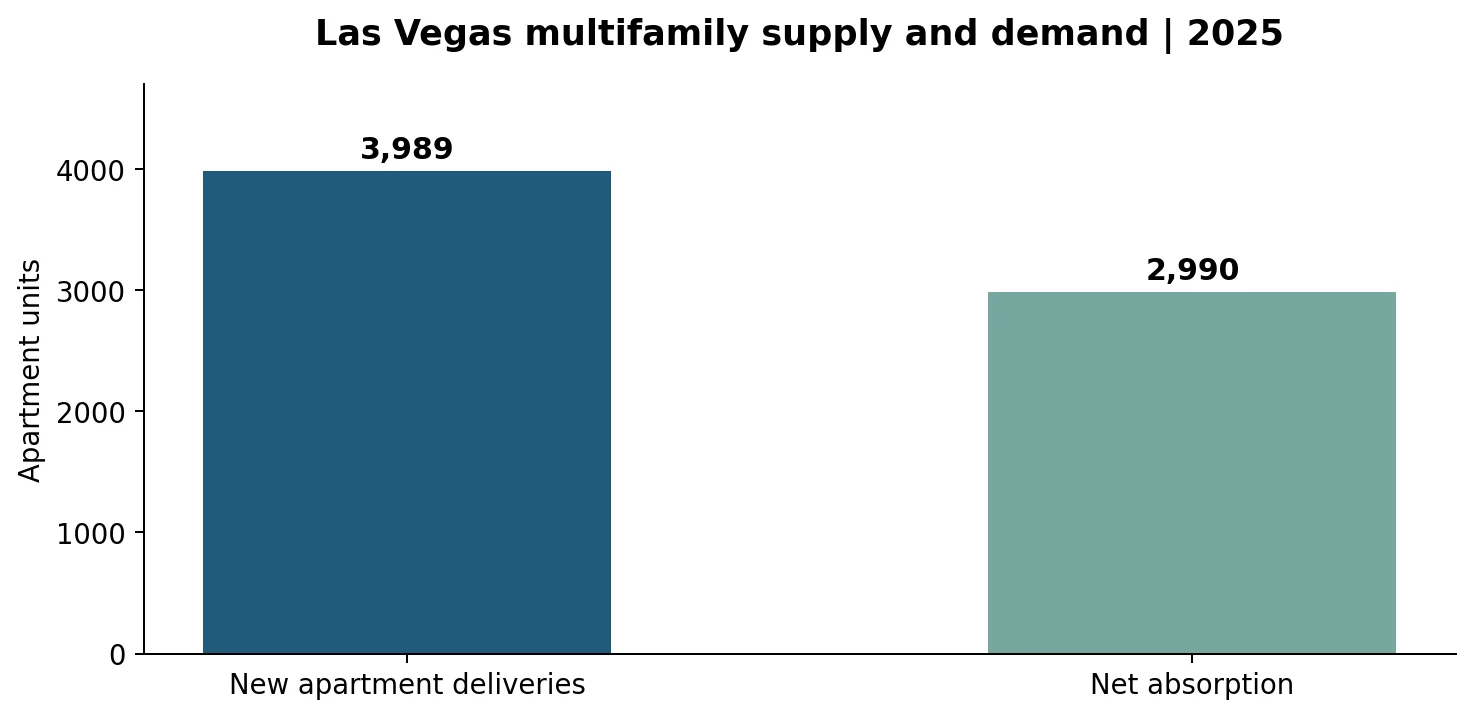
Cushman & Wakefield's Q4 2025 multifamily report recorded 3,989 apartment deliveries and 2,990 units of net absorption during 2025. Deliveries are completed units entering inventory; net absorption is the change in occupied units across the measured apartment market. The difference of 999 units does not mean exactly 999 newly built apartments were left vacant.
Figure 1. Full-year 2025 apartment deliveries and net absorption. Source: Cushman & Wakefield/CoStar, Q4 2025.
What the Numbers Mean: Demand remained positive, but deliveries exceeded net growth in occupied units, contributing to a competitive leasing environment.
Vacancy and Single-Family Competition
Cushman & Wakefield reported 10.6% multifamily vacancy in Q1 2026 for its surveyed apartment inventory. This is not the vacancy rate for all detached rental homes. New apartments can nevertheless compete with smaller houses, condos and townhomes where rents and amenities overlap. Larger detached homes may serve different renter preferences.
Build-to-Rent Communities and Permits
Build-to-rent developments are homes constructed for rental occupancy, often offering yards and amenities similar to individually owned rentals. They can directly compete with suburban single-family properties. Building permits provide early evidence of future supply but are not completed homes; projects may change or be delayed.
What This Means for Landlords: Compare the number of similar homes entering the immediate neighborhood with the likely pool of renters, not simply the countywide population growth rate.
4. Rental Prices & Market Conditions: How We Measure the Market
Zillow Observed Rent Index (ZORI)
Rentals America uses the Zillow Observed Rent Index (ZORI), developed by Zillow Research, in monthly market updates. ZORI tracks asking-rent trends using repeated listings and statistical adjustments rather than simply averaging whichever homes are currently advertised. It does not measure every final signed lease or set the rent for an individual property.
Indicators to Consider Together
Month-over-month vs. year-over-year. Monthly changes can reflect seasonal noise; annual changes compare with the same month a year earlier and usually better show the broader direction.
Rental inventory and days on market. More competing listings and longer marketing periods can reveal softer conditions even when advertised rents are stable.
Rental concessions. Move-in incentives can lower effective rental costs without changing headline asking rents.
Affordability. Income, employment, mortgage costs and living expenses influence both renting versus buying and what households can afford.
Seasonality. Moving activity changes with employment, schools and household needs; patterns differ across property types.
What This Means for Landlords: Use metro rent trends as a starting point, then examine nearby comparable listings, incentives, leasing activity and property condition. For current figures, see our monthly Las Vegas Rental Market Updates.
5. Las Vegas-Area Communities: One Region, Different Rental Markets
Many areas commonly called "Las Vegas" are in unincorporated Clark County, not the incorporated City of Las Vegas. This includes substantial portions of Summerlin, Paradise, Spring Valley and Enterprise. Municipal population figures therefore do not describe the entire valley.
Clark County Municipal Population, 2025
Municipality
2025 local estimate
Las Vegas
691,886
Henderson
366,071
North Las Vegas
294,125
Mesquite
24,437
Boulder City
14,987
Source: Clark County Comprehensive Planning. Incorporated municipalities only; adjacent unincorporated neighborhoods are excluded.
Population Growth Across Southern Nevada, 2020–2025
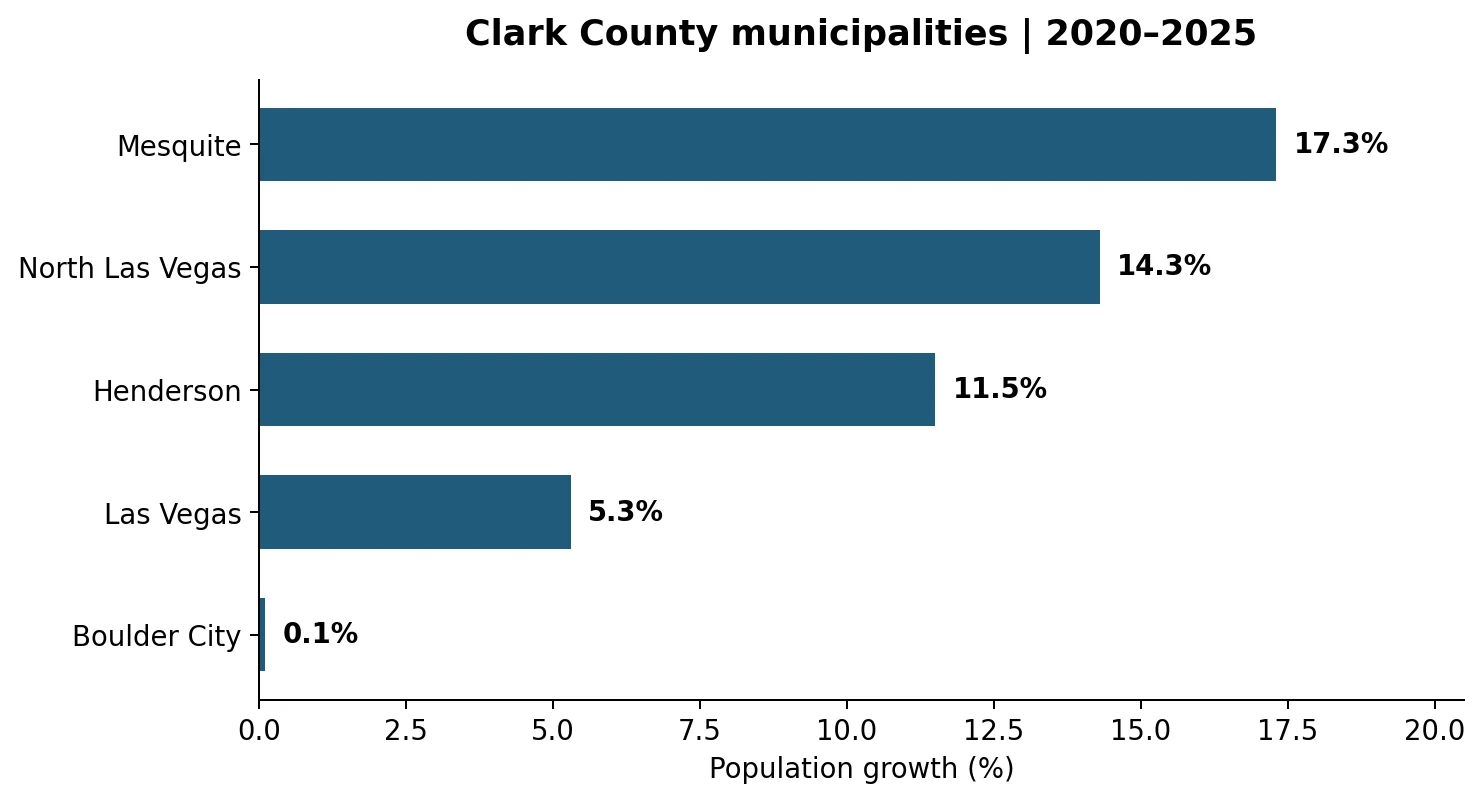
Using a consistent U.S. Census Bureau 2020 baseline and Vintage 2025 estimates, Mesquite grew approximately 17.3%, North Las Vegas 14.3%, Henderson 11.5%, and Las Vegas 5.3%, while Boulder City was nearly unchanged at 0.1%. These Census-based growth percentages should not be computed from the separate Clark County local estimates above.
Figure 2. Percentage population growth, 2020–2025. Source: U.S. Census Bureau, Vintage 2025 estimates; rounded to one decimal.
What the Numbers Mean: Fast-growing municipalities can support demand but also add more housing. The balance of new households and new supply matters more than growth alone.
Las Vegas
2025 Population: 691,886
The incorporated city spans established central neighborhoods, downtown and northwest residential areas.
Rental Market Perspective: A central older home and a newer northwest home face different competing inventory.
Henderson
2025 Population: 366,071
Green Valley, Anthem, Inspirada and Cadence illustrate its range of established and growing communities.
Rental Market Perspective: Compare similar homes within the relevant development, especially where new subdivisions are delivering inventory.
North Las Vegas
2025 Population: 294,125
Established neighborhoods coexist with expanding subdivisions and industrial/logistics corridors.
Rental Market Perspective: Employment access supports demand, but new housing supply can intensify competition.
Summerlin
A large western master-planned community spanning incorporated and unincorporated areas.
Rental Market Perspective: Neighborhood, home age, amenities and newer competing listings create substantial variation.
Enterprise and Southwest Valley
Unincorporated southwest communities include established and expanding residential developments.
Rental Market Perspective: Apartments, subdivisions and build-to-rent communities can introduce competing options.
Spring Valley
An established unincorporated community with older homes, condos, townhomes and apartments.
Rental Market Perspective: Convenience and location matter, but condition and upgrades can distinguish older properties.
Paradise and Central Valley
An unincorporated area including much of the Strip, airport and surrounding neighborhoods.
Rental Market Perspective: Employment proximity helps, but renters also weigh affordability, transportation and condition.
Southern Highlands and South Valley
Master-planned communities and newer housing with access to I-15 and southern job corridors.
Rental Market Perspective: Subdivision-level availability and similar detached homes are critical comparables.
Boulder City
2025 Population: 14,987
A smaller established community with distinctive housing and development patterns.
Rental Market Perspective: Scarce local comparables and specific property characteristics may matter more than valley averages.
Mesquite
2025 Population: 24,437
Northeast of the main valley, with retirement-oriented and newer communities.
Rental Market Perspective: Evaluate it as a distinct local rental market rather than assuming central Las Vegas conditions apply.
Community Takeaway: Established neighborhoods compete on location and housing characteristics; growing suburbs also face fresh supply; master-planned communities may introduce many similar listings.
6. What Rentals America Has Observed
New Construction Can Change Competition Quickly
Multiple similar properties can become available within a short period in developing neighborhoods.
Our Perspective: The number of competing homes nearby can matter more than regional population growth for immediate leasing.
The Las Vegas Valley Contains Distinct Rental Markets
A Henderson detached home, a Strip-area condo and a northwest new-build appeal to different renters.
Our Perspective: Use property-level comparables rather than relying only on metropolitan averages.
Advertised Rent Is Not Achieved Rent
Asking prices may differ from executed lease rents because of concessions, marketing time and condition.
Our Perspective: Evaluate asking prices alongside actual leasing outcomes and competing inventory.
Employment Growth Does Not Affect Every Neighborhood Equally
Job centers are distributed across the region and workers choose housing based on many factors.
Our Perspective: An employment announcement does not automatically produce nearby rent growth.
Long-Term Growth Does Not Eliminate Short-Term Weakness
Population and economic activity support long-run demand while new construction and affordability can soften conditions.
Our Perspective: Distinguish durable regional fundamentals from the immediate competition affecting a property.
7. How to Use This Report
Start with regional fundamentals. Population and employment explain long-term demand.
Evaluate housing supply. Construction, vacancies and development activity show available alternatives.
Review current rental indicators. Asking rents, inventory, concessions and leasing activity reflect present conditions.
Narrow to the property. Neighborhood, size, condition, amenities and comparable listings determine its competitive position.
Different sources use different geographic boundaries, definitions and reporting periods. Historical figures provide context rather than a guarantee of future conditions.
About This Report
Prepared by Rentals America, a residential property management company serving Las Vegas-area owners. The report combines publicly available economic and housing research with confirmed company observations.